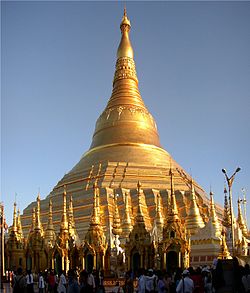
Sunday, November 22, 2009

Reverence to cetiyas

Should we Buddhists paid respect to cetiyas? Some of us may think that those who did are ignorant of Buddhist's practices. However, in yesterday Dhamma Talk, Venerable Sayadaw U Vimala said it is in accordance to the Teaching of The Buddha that one gains Kusala Kamma for respecting the cetiyas.

There are five types of cetiyas namely,
  1. Paribhoga Cetiya- enshrined with requisites used by the Buddha
  2. Uddissaka Cetiya- built or made in remembrance of the Buddha
  3. Dhatu Cetiya- enshrined with the relics of the Buddha
  4. Dhamma Cetiya
  5. Pada Cetiya- foot prints of the Buddha
This means that as Buddhists, we should and can give our respect and offering to these cetiyas. For example, Buddha images are the Uddissaka Cetiya which we should be paying respect to whenever we enter a temple or Buddhist meditation centre. Even places that houses the Dhamma books should be respected.

Further interesting information on cetiyas can be obtained from these sites (1), (2), (3)

Saturday, November 14, 2009

Worthy of A Stupa

Most Malaysian Buddhists do not view Buddhist stupas as significant to Buddhism although stupa is one of the objects of reverence in Buddhism.

In tonight Dhamma Talk, Sayadaw U Vimala teaches us the importance of stupas in Buddhism.

Stupas are used to house the remains of the Buddha. In the Mahaparinibbana Sutta, the Buddha mentioned that there are 4 types of person worthy of being enshrined in a stupa. They are namely
  1. A Samma Sambuddha
  2. A Pacekka Buddha
  3. An Arahanta
  4. An universal monarch
Sayadaw said that reverence such as offerings of flowers or water can be made to a stupa and in the commentaries, such action can assists a person to be reborn as human or devas.

Sister Gin also mentioned about the great reverence of the stupa to the Burmese people during our retreat at Santarama BH.

But, in my opinion, Chinese Malaysians had the outmost extreme zeal in paying reverence to inanimate objects such as stones, idols etc. Right understanding in paying reverences to objects had to cultivated in the Buddhist practice so that ancestral practices of worshiping do not cloud the importance of paying respect in Buddhism.

Otherwise, we are going to have a real hard time in maintaining correct atmosphere in Buddhist places especially in meditation centers.

Sadhu, sadhu, sadhu.

The Theras

Titles may be trivial or petty matters but sometimes it may be important to us when we are addressing or make reference to a person.

Tonight before the Dhamma talk, Sayadaw mentioned that people here are ignorant of the terms nava, majjhima, thera and mahathera. Many people used wrong titles of Mahathera when refering to a bhikkhu even though the bhikkhu is only had one vassa. Here, Sayadaw taught us the proper usage of these 4 terms:
  1. Nava bhikkhu refers to bhikkhu who has less than 5 vassas
  2. Majjhima bhikkhu refers to bhikkhu who has 5 to 9 vassas
  3. Thera bhikkhu refers to bhikkhu who has 20 or less than 20 vassas
  4. MahaThera bhikkhu refers to bhikkhu who has more than 20 vassas
  • Further clarification of these terms can be checked from this link.
Reverence to the title of Maha Thera must be done correctly, reflecting the seniority of the bhikkhu and not to the convenience of the devotees.

Sadhu, sadhu, sadhu.

Sunday, November 8, 2009

Return from Balik Pulau #2

Some 'light' moments during the retreat.


Back from Balik Pulau #1

What a tiring day! A 12-hour meditation exercise (with 2 free meals) was tiring but interesting. Together with about another 30 yogis under the guardance of Sister Gavesini, Amy and I managed to complete our second retreat of the year. Both of us agreed that we had a better experience from this retreat due to regular daily practices prior to this retreat. I can even managed to do each of the sitting and walking meditation sessions for a full one hour-period (even though the five nirvaranas starts to their attack after lunch). A very big Maha Sadhu to Sis. Gin, Bro Kean Beng (where is my KFC), Sis Hong Bian and Bro Sunanda Lim of House of Inward Journey (for hosting this course) and not forgetting all the Dhamma dayakas (who sponsored and ensured that meals are provided for us during the retreat). Another retreat? Heeeheee


Saturday, November 7, 2009

Vipassana Meditation Retreat at Santarama

Today, Amy and I will be staying at Santarama, Balik Pulau for 2-days-1-night vipassana meditation retreat as part of the meditation course that both of us joined for the past two months. This couse is conducted by a very experienced lay-teacher Sister Gavesini at House of Inward Journey. It must be a good year for me this year for having the opportunity of attending not one but two retreats for a year (after many many years of not attending any since the 1980s). Expectation none, as Bhante Suvanno had said, it not our mind that we can decide, just take it as it come. Let's see....

Saturday, October 24, 2009

The Naked Truth

We do not understand about the concept of non-self, we thought we know but actually we do not know. It is wonderful to be able to hear tonight talk about Acela Sutta from Sayadaw U Vimala at BMBMC.

Most of us have either the eternalist or annihilationist views about self. We think of us as permanent even though we know that The Buddha taught us that there is anatta. Learning from this Sutta, Sayadaw said that if we think that we are the same person, for example, we think that if we perform dana now and later we will be born in heavenly realm; the 'we' is the same person then we have the eternalist wrong view. On the other hand, if we then think that the 'we' is different, then we have the annihilationist wrong views. Actually there is no 'we'.

Oh! Oh! Here goes the understanding in most of us. But then, in satipatthana meditation we had always been advised to watch the five aggregates namely nama (made out of 4 aggregates) and rupa (1 aggregate).

In a moment, the combination of the five aggregates is unique but then will changed in the next moment. So we cannot said that there is no person in that moment in the conventional truth as there are the five aggregates coming together, but in the next moment that the person that exist is not of the same aggregrates. Confusing isn't it.

The importance of Pattica Samuppada is also shown in this Sutta. Sayadaw said that every Buddha will have to contemplate on the Dependent Origination before becoming Enlightened. Reflecting on the Dependent Origination, The Buddha knows and understands suffering, it's cause, it's cessation and how to cause its cessation.
Mind our views - that's the gist of tonight talk.

Sadhu, sadhu, sadhu.
http://hk.geocities.com/dhammachanda_1/vb/p79e.gif
http://www.wakarusa.com/images/artists_musiclineup/Nama-Rupa.jpg